Rehabilitation robots are moving toward a harder test: helping people repeat useful movements in clinics and at home. Without a supplied evidence pack, the safest way to judge the field is to watch the mechanisms, the proof, and the limits rather than repeat product claims.
- Better control should match the patient’s movement instead of forcing a fixed path.
- Home systems need clear safety checks and simple setup.
- A real advance needs clinical results, not a polished demonstration.
Robots that adjust to the patient
Many rehabilitation systems guide a limb through repeated motion. The next step is better control of how much help the robot gives. A patient who can move part of the way may need light support, while another patient may need the robot to do more of the work.
That adjustment matters because therapy depends on useful repetition. If the robot takes over every movement, the patient may complete more repetitions without doing the hard part themselves. If it gives too little help, the session may stop early or produce poor movement.
The test to watch is simple: does the system change its assistance as the patient’s strength changes during a session? Product makers should show the control method, the task used to test it, and results from a named clinical study.
Smaller systems for home therapy
Clinic robots can rely on trained staff, fixed rooms, and close supervision. A home robot has to work with less space and fewer people nearby, so its design must account for setup, charging, fit, cleaning, and fault recovery.
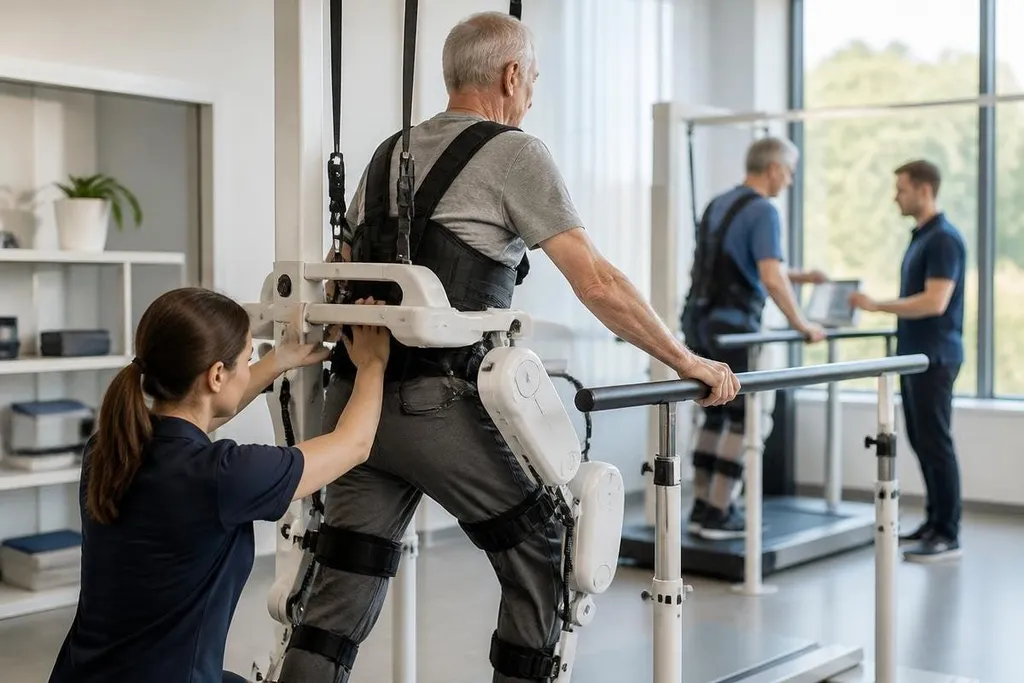
Wearable robots may help with walking or arm movement. A wearable exoskeleton is a frame that supports a person’s joints while they move.
For home use, its weight and contact points matter as much as its motors. A device that takes too long to fit may see little use, even if its movement control works well.
A rehabilitation robot can work well in a clinic and still fail at home if fitting takes too long or the user needs help between sessions. Rehabilitation robotics reports from Robot24.com can place the device, trial setting, and home-use results together. That gap leads to the next issue: how well the system reads movement from the body.
Better feedback from the body
A rehabilitation robot needs information about movement. Cameras can track posture, force sensors can measure contact, and motion sensors can record joint movement. The system then uses that data to decide how much help to give.
The next gains may come from better feedback rather than larger motors. A robot that notices a change in balance or grip can adjust the task before the movement becomes unsafe. That claim still needs proof: the maker should state which sensors it uses, how fast the system reacts, and how often it makes a wrong decision.
Privacy also belongs in this test. Home systems may collect video, motion data, or health records. Buyers need to know where that data is stored, who can see it, and how long the company keeps it.
Proof beyond the demo
A demonstration can show that a robot completes one task. It can’t show how the system works across different bodies, injuries, homes, and therapy plans. Those questions need published methods and patient results.
The useful evidence will include the number of patients, the length of treatment, the comparison group, and the measure used to judge progress. A study should also report dropouts and safety events. Without those details, a claim about better recovery remains unproven.
I'd skip any purchase decision based on a video alone. Ask for the study, the service plan, and the cost of keeping the robot working after the warranty ends.
A buyer’s checklist
Use these questions before giving a clinic, care provider, or home patient a budget:
- Clinical proof: Which named study measured patient results, and how many people took part?
- Help level: Can a therapist set the amount of assistance for each task?
- Safety: What stops the motors when the patient loses balance or the sensor fails?
- Daily use: How long does setup take, and who can fit or adjust the device?
- Data control: What information does the system collect, and where does it go?
- Service cost: Who repairs the robot, and what parts or visits cost extra?
The field will earn its strongest proof when a rehabilitation robot shows lasting patient improvement outside a controlled demo. Until makers publish that evidence, the right question is not how advanced the robot looks, but how well it helps one person move on the next day.